Commercial Electricity Rates Ontario: The Complete Business Guide (2026)
Commercial electricity rates Ontario businesses pay are one of the largest operating expenses for manufacturers, warehouses, hotels, restaurants, office buildings, retail stores, and other commercial facilities. Understanding how retailer pricing, Global Adjustment, demand charges, and contract terms work can help businesses better evaluate their electricity costs and identify opportunities for further review.
Many business owners assume that high electricity bills are unavoidable. In reality, commercial electricity invoices are often complex and may contain pricing structures, contract provisions, or billing details that warrant a closer review.
At The Bill Advisers, we help Ontario businesses understand their commercial electricity bills and identify opportunities to reduce ongoing operating costs.
Key Takeaways
- Commercial electricity rates in Ontario include energy, demand, Global Adjustment, delivery, and regulatory charges.
- Retailer contracts should be reviewed periodically.
- Billing accuracy is just as important as electricity pricing.
- Businesses should understand how their invoices are calculated before making purchasing decisions.
- An independent review can help identify areas that warrant further investigation.
- Understanding commercial electricity rates in Ontario starts with understanding your retailer invoice—not just the total amount due.
Why Are Commercial Electricity Bills So High?
Commercial electricity bills are made up of far more than the price of electricity itself.
Every business should understand how commercial electricity rates Ontario retailers offer compare with current market conditions. Periodically reviewing contracts and invoices can help identify pricing differences, billing inconsistencies, and opportunities for further investigation.
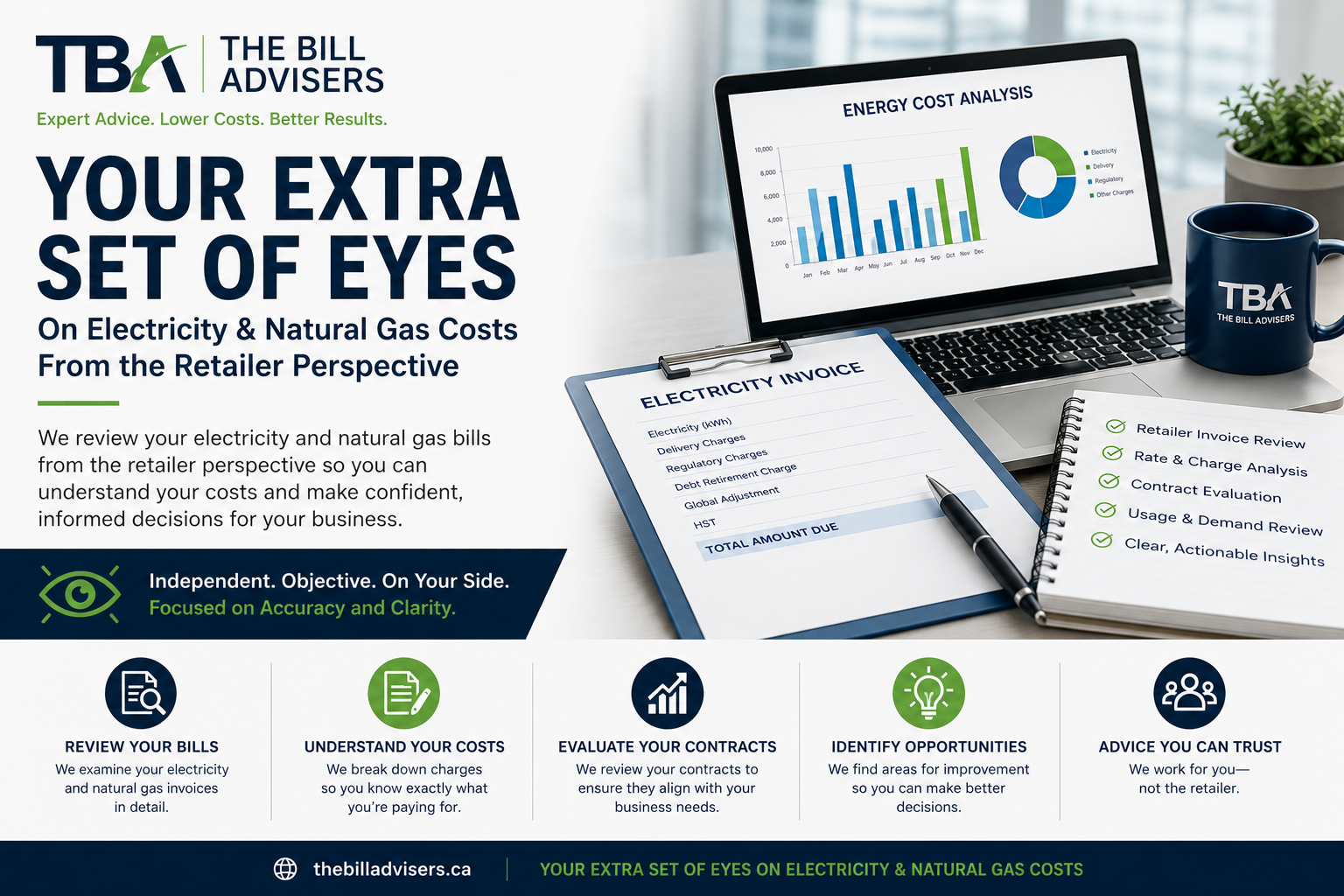
Depending on your business, your monthly bill may include:
- Electricity consumption (kWh)
- Demand charges (kW)
- Global Adjustment (Ontario)
- Delivery charges
- Regulatory charges
- Debt retirement adjustments (where applicable)
- Taxes
- Retailer or supplier charges
Many businesses focus only on the total amount due without understanding which components have the greatest impact on their monthly costs.
Commercial electricity invoices contain numerous individual charges that can change from month to month. While electricity consumption is an important factor, businesses should also understand demand charges, delivery costs, Global Adjustment, transmission charges, retailer pricing, and applicable taxes.
Businesses operating multiple locations often discover that two facilities with similar electricity consumption can have very different invoices because of differences in contract pricing, billing classifications, operating schedules, or utility territories.
Understanding these differences helps organizations ask better questions when reviewing electricity invoices and comparing supplier agreements.
Commercial Electricity Rates Ontario: Understanding Business Pricing
Unlike residential customers, commercial electricity customers may qualify for different pricing structures depending on:
- Annual electricity usage
- Peak demand
- Business type
- Voltage level
- Utility territory
- Electricity supplier
- Contract terms
Some businesses purchase electricity directly from their local distribution company, while others enter into contracts with licensed energy retailers.
Businesses should also understand that electricity pricing is only one component of an overall electricity invoice. Contract structure, demand profile, operating hours, and retailer billing practices can all influence the total monthly cost.
Reviewing these factors together provides a more complete understanding of commercial electricity rates in Ontario.
Choosing the wrong contract—or failing to review an existing one—can result in higher costs over several years.
The Independent Electricity System Operator (IESO) manages Ontario’s electricity system and publishes information about Global Adjustment, demand, and provincial electricity markets. Businesses looking to better understand how these charges are calculated can review the resources available on the IESO website.
The Ontario Energy Board (OEB) is the independent regulator responsible for overseeing Ontario’s electricity and natural gas sectors. The OEB provides information about electricity distributors, licensed retailers, customer rights, and how electricity pricing works. Businesses looking to better understand Ontario’s electricity market can review educational resources available on the Ontario Energy Board website.
What Is Driving Business Electricity Costs?
Several factors influence Ontario commercial electricity rates.
1. Global Adjustment
For many medium and large commercial customers, Global Adjustment represents one of the largest portions of an electricity invoice.
Although the calculation is complex, businesses should understand that operational demand during provincial peak periods can influence future Global Adjustment costs.
Organizations with significant electricity usage often review operational schedules and demand profiles to better understand how these charges affect long-term electricity costs.
2. Demand Charges
Demand charges are based on the highest level of electricity demand recorded during a billing period rather than total energy consumption.
A brief increase in electricity demand—even lasting only a few minutes—may affect monthly charges.
Understanding when demand spikes occur helps businesses better evaluate operational schedules and equipment usage.
3. Electricity Contracts
Commercial electricity contracts often include renewal provisions, pricing methodologies, contract lengths, early termination clauses, and retailer-specific terms.
Businesses should periodically compare existing agreements with current market offerings to better understand whether their existing contract still aligns with operational requirements.
4. Billing Errors
Commercial utility invoices are complex.
Common issues include:
- Incorrect billing classifications
- Rate code errors
- Contract discrepancies
- Duplicate charges
- Incorrect demand calculations
- Missed adjustments
Commercial electricity invoices contain significant amounts of billing data. Even when electricity consumption remains stable, incorrect rate codes, duplicate charges, billing classifications, or contract discrepancies may affect invoice accuracy.
Reviewing invoices periodically helps businesses better understand how electricity costs are calculated and identify items that warrant clarification.
Even small billing errors can accumulate into significant costs over time.
How Businesses Can Reduce Commercial Electricity Costs
Reducing electricity costs does not necessarily require using less electricity.
Rather than focusing only on reducing electricity usage, many organizations first work to better understand how their invoices are structured.
Invoice reviews can help businesses understand retailer pricing, billing classifications, demand patterns, contract terms, and historical usage trends before making purchasing decisions.
Potential opportunities include:
- Reviewing electricity contracts
- Verifying billing accuracy
- Evaluating demand charges
- Monitoring Global Adjustment exposure
- Comparing supplier pricing
- Identifying operational improvements
- Reviewing tariff classifications
- Benchmarking against similar businesses
Every business is different, making professional analysis valuable before implementing changes.
Industries That Can Benefit
Commercial electricity optimization can benefit many industries, including:
- Manufacturing
- Hotels
- Restaurants
- Warehousing
- Distribution
- Property Management
- Office Buildings
- Automotive
- Food Processing
- Healthcare
- Retail
- Multi-location businesses
While every industry has unique operating requirements, organizations with multiple facilities or high electricity consumption often benefit most from regularly reviewing commercial electricity invoices.
Why Work With The Bill Advisers?
Unlike energy retailers, The Bill Advisers works on behalf of businesses—not Utility or Retailer companies.
Our role is not to sell electricity.
Our role is to help businesses better understand how retailer invoices are structured, how contracts affect ongoing costs, and whether billing information appears consistent with the applicable agreement.
We act as an independent extra set of eyes so organizations can make informed decisions based on a clearer understanding of their electricity costs.
Our team analyzes:
- Commercial electricity bills
- Electricity contracts
- Historical usage
- Demand patterns
- Billing accuracy
- Supplier arrangements
- Potential cost-saving opportunities
The goal is straightforward: help businesses make informed decisions that can improve their bottom line.
Frequently Asked Questions
What are commercial electricity rates in Ontario?
Commercial electricity rates vary depending on electricity consumption, demand, location, pricing structure, and other billing components such as delivery charges and Global Adjustment.
Can businesses lower their electricity bills?
Yes. Many businesses can reduce electricity costs through contract reviews, billing analysis, demand management, and identifying pricing or billing opportunities.
Should I review my electricity contract?
If your contract has not been reviewed in several years, or if your business has changed significantly, a review may identify opportunities to improve pricing or terms.
What is a commercial electricity audit?
A commercial electricity audit involves reviewing invoices, pricing, contracts, billing classifications, and usage patterns to identify potential savings opportunities.
Request a Complimentary Commercial Electricity Bill Review
If your business is concerned about rising electricity costs, The Bill Advisers offers a complimentary commercial electricity bill review.
We’ll analyze your electricity invoices, explain how your charges are calculated, and identify opportunities that may help reduce your ongoing operating expenses.
Whether your organization operates a single location or multiple facilities, understanding commercial electricity rates Ontario businesses face can provide greater confidence when reviewing electricity retailer invoices, contract terms, and ongoing operating costs.
Request your complimentary commercial electricity bill review today. Our team will review your retailer invoices, contracts, billing structure, and charges to help you better understand your electricity costs and identify opportunities that may warrant further investigation.