Merchant Services for Canadian Businesses: The Complete Guide to Payment Processing Fees (2026)
Merchant Services for Canadian Businesses: The Complete Guide to Payment Processing Fees (2026)
Every day, millions of Canadians pay for products and services using credit cards, debit cards, mobile wallets, and other electronic payment methods. Behind every transaction is a payment processing system that allows businesses to accept payments quickly and securely.
For most business owners, however, merchant services remain one of the least understood operating expenses.
Many businesses review their merchant statement each month only to confirm the total amount withdrawn from their bank account. Few understand how those fees are calculated, what the individual charges represent, or whether they are paying competitive rates. As a result, unreviewed costs can continue for years without anyone questioning them.
Merchant processing costs are made up of much more than a single percentage rate. Businesses may encounter interchange fees, processor markups, monthly account fees, PCI compliance charges, terminal rental costs, gateway fees, statement fees, chargeback fees, and various contract-related expenses. Understanding these charges is the first step toward managing them effectively.
Whether your organization processes a few thousand dollars each month or millions of dollars annually, payment processing costs deserve the same attention as electricity, telecommunications, insurance, or any other major operating expense. Small improvements in processing rates, contract terms, or fee structures can create meaningful long-term cost reductions.
This guide explains how merchant services work in Canada, how credit card processing fees are calculated, how to read a merchant statement, and what business owners should understand before signing or renewing a merchant services agreement.
Key Takeaways
- Merchant services include the technology, financial institutions, and payment processors that allow businesses to accept electronic payments.
- Credit card processing fees are made up of several components, including interchange fees, processor markups, assessment fees, and service charges.
- Merchant statements often contain dozens of individual line items that many business owners never review in detail.
- Merchant account agreements can include automatic renewals, equipment leases, cancellation clauses, and pricing structures that affect long-term operating costs.
- PCI compliance fees, terminal rental charges, gateway fees, and monthly account fees can significantly increase the total cost of payment processing.
- Reviewing merchant statements regularly can help identify billing discrepancies, outdated pricing, unnecessary services, or opportunities to improve contract terms.
- Understanding your merchant services agreement allows your business to make informed financial decisions rather than relying solely on your payment processor’s recommendations.
What Are Merchant Services?
Merchant services refer to the products, technology, financial services, and payment processing systems that enable businesses to accept electronic payments from customers. Every time a customer taps a debit card, inserts a credit card, pays online, or completes a mobile wallet transaction, multiple organizations work together behind the scenes to authorize, process, and settle that payment.
Merchant services are not provided by a single company. Instead, they involve a network of participants, including payment processors, acquiring banks, card networks such as Visa and Mastercard, issuing banks, payment gateways, and point-of-sale systems. Together, these organizations ensure that payments are authorized securely and that funds are transferred from the customer’s financial institution to the business.
A complete merchant services solution may include:
- A merchant account
- Credit and debit card processing
- Point-of-sale (POS) terminals
- Online payment gateways
- Mobile payment solutions
- Virtual terminals
- E-commerce payment processing
- Payment reporting and analytics
- Fraud prevention tools
- Chargeback management
- Customer receipt systems
- Settlement and deposit services
Although many business owners use the terms merchant services, merchant processing, and payment processing interchangeably, they describe different parts of the same system.
Merchant services is the broad category that encompasses all payment acceptance solutions.
Merchant processing refers to the movement of payment information from the customer’s payment method through the processing network until the transaction is approved and settled.
A payment processor is the company responsible for routing transaction data between merchants, card networks, and financial institutions.
A merchant account is a specialized account that temporarily receives approved credit card and debit card transactions before funds are deposited into the business’s bank account.
For most businesses, these services operate quietly in the background. Customers complete a purchase within seconds without realizing that multiple organizations have communicated with one another to approve the transaction and transfer the funds.
Because the process happens so quickly, many business owners assume that payment processing is straightforward. In reality, every transaction passes through several stages, each with its own costs and pricing rules. Those costs ultimately appear on the monthly merchant statement, where they are often grouped into categories that can be difficult to interpret without experience.
Understanding how merchant services operate provides the foundation for understanding every fee that appears on a merchant statement. Once a business owner understands who participates in the payment process and why each organization is compensated, it becomes much easier to evaluate pricing, compare providers, and identify opportunities to reduce unnecessary costs.
How Merchant Services Process Credit Card Payments
Every time a customer pays with a credit card, debit card, smartphone, or contactless payment method, an extensive financial network works behind the scenes to complete the transaction—often in just two or three seconds.
Although the process appears simple to the customer, several organizations participate in every payment, and each plays a specific role. Understanding who these participants are and how they interact helps explain why businesses pay multiple types of payment processing fees rather than a single flat rate.
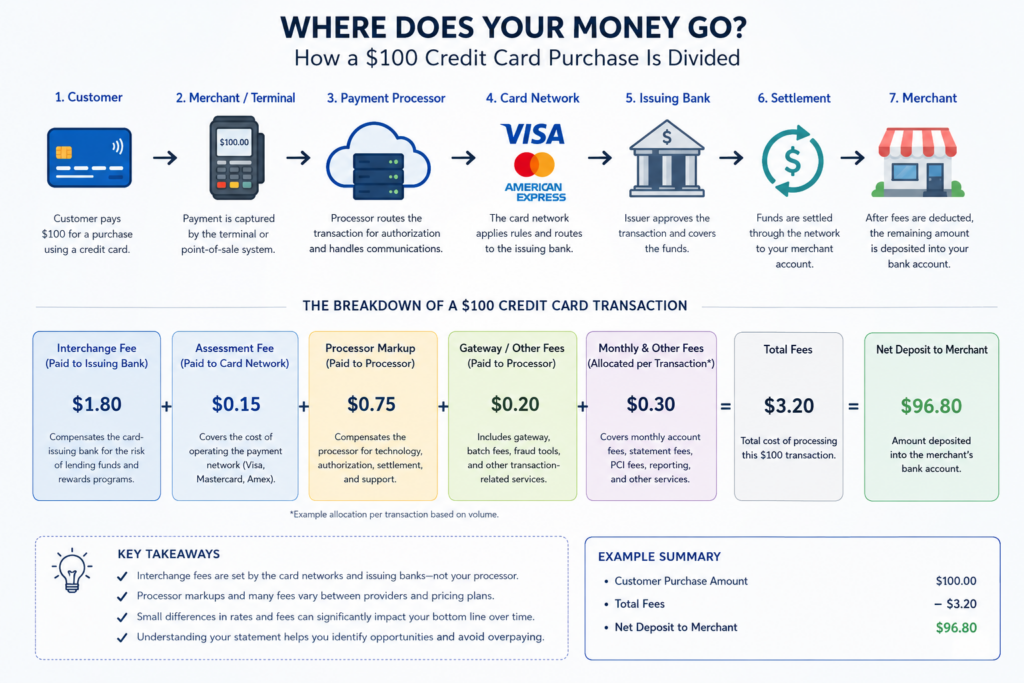
The following simplified transaction flow illustrates what happens when a customer makes a purchase.
Customer
│
▼
Payment Terminal / Point-of-Sale System
│
▼
Payment Processor
│
▼
Card Network
(Visa, Mastercard, American Express, Interac)
│
▼
Customer’s Issuing Bank
│
▼
Approval or Decline
│
▼
Settlement
│
▼
Merchant Account
│
▼
Business Bank Account
Step 1 – The Customer Initiates the Purchase
The payment process begins when a customer chooses to pay using a credit card, debit card, mobile wallet (such as Apple Pay or Google Pay), or another supported electronic payment method.
The customer may:
- Tap a contactless card
- Insert a chip card
- Swipe a magnetic stripe card
- Pay online
- Use a smartphone or smartwatch
- Enter payment information manually
At this point, the customer’s payment information is securely encrypted before it ever leaves the payment device.
This protects sensitive financial information and helps reduce the risk of fraud.
Step 2 – The Payment Terminal Captures the Transaction
The payment terminal or point-of-sale (POS) system collects the transaction details.
Typical information includes:
- Purchase amount
- Date and time
- Merchant identification number
- Terminal identification number
- Currency
- Card information
- Security credentials
Modern payment terminals also perform important security functions, including encryption and tokenization, helping protect cardholder data during transmission.
If the business operates online, this role is performed by a secure payment gateway rather than a physical payment terminal.
Step 3 – The Payment Processor Receives the Request
Once the transaction is captured, it is transmitted to the payment processor.
The payment processor acts as the communication hub for the transaction.
Its responsibilities include:
- Receiving encrypted transaction information
- Verifying transaction formatting
- Performing fraud screening
- Routing the transaction to the appropriate card network
- Managing communication between all parties
The payment processor does not decide whether the payment is approved.
Instead, it ensures that the transaction reaches the appropriate financial institutions as quickly and securely as possible.
Because payment processors maintain sophisticated infrastructure capable of handling millions of transactions every day, they charge businesses processing fees for their services.
Step 4 – The Card Network Routes the Transaction
After leaving the payment processor, the transaction is forwarded to the appropriate card network.
Examples include:
- Visa
- Mastercard
- American Express
- Interac (for Canadian debit transactions)
Card networks establish many of the operating rules that govern payment processing.
They determine:
- Security standards
- Transaction routing requirements
- Network assessment fees
- Technical operating procedures
Although businesses often assume their payment processor determines all pricing, card networks establish many of the fees that appear on merchant statements.
These fees are generally standardized across the industry and are not controlled by the merchant services provider.
Step 5 – The Customer’s Bank Makes the Decision
The card network forwards the authorization request to the customer’s issuing bank.
This is the financial institution that issued the customer’s credit or debit card.
The issuing bank evaluates several factors before approving the purchase.
These include:
- Available credit
- Available account balance
- Account status
- Fraud detection systems
- Spending patterns
- Card expiration
- Security verification
If everything appears valid, the bank approves the transaction.
If not, the transaction may be declined for reasons such as insufficient funds, suspected fraud, an expired card, or account restrictions.
This authorization typically occurs in only a few seconds.
Step 6 – The Approval Travels Back Through the Network
Once the issuing bank makes its decision, the response travels back through the same network.
Issuing Bank
↓
Card Network
↓
Payment Processor
↓
Payment Terminal
↓
Merchant
↓
Customer
If approved, the terminal displays an approval message, and the customer receives a receipt.
From the customer’s perspective, the transaction is complete.
From the merchant’s perspective, however, several important financial steps are still taking place behind the scenes.
Step 7 – Settlement and Funding
Authorization confirms that the funds are available.
Settlement is the process of actually transferring those funds.
Most businesses submit their approved transactions in batches throughout the day.
At the end of each business day—or at scheduled intervals—the payment processor submits those transactions for settlement.
During settlement:
- The issuing bank transfers funds.
- The card network reconciles the transaction.
- Processing fees are deducted.
- The merchant account receives the remaining funds.
- The balance is deposited into the business’s operating bank account.
Depending on the payment processor and the merchant agreement, deposits may occur:
- The same day
- Next business day
- Two or more business days later
Settlement timing varies by provider, payment method, weekends, holidays, and banking schedules.
Why Does Every Transaction Include Multiple Fees?
One of the most common questions business owners ask is:
“If my customer paid $100, why didn’t I receive the full $100?”
The answer is that every organization involved in the payment process performs a specific function and is compensated for its role.
A simplified breakdown looks like this:
| Participant | Primary Responsibility | Typical Compensation |
| Issuing Bank | Provides the customer’s credit or debit card and assumes the financial risk of the transaction. | Interchange Fees |
| Card Network | Operates the payment network and establishes transaction rules. | Assessment Fees |
| Payment Processor | Routes transactions, provides technology, settlement services, and merchant support. | Processor Markup and Service Fees |
| Merchant Services Provider | Supplies terminals, reporting tools, customer support, payment gateways, and account management. | Monthly Fees, Equipment Charges, Gateway Fees, or Service Fees |
This explains why a merchant statement often contains several different fee categories rather than one simple processing percentage.
Why Businesses Should Understand This Process
For many organizations, payment processing is viewed simply as another monthly expense. However, understanding how a transaction moves through the payment ecosystem provides valuable context when reviewing merchant statements or evaluating service providers.
A business owner who understands the payment process is better equipped to:
- Compare merchant service providers objectively.
- Understand where processing costs originate.
- Identify unnecessary fees or duplicate charges.
- Evaluate pricing proposals with greater confidence.
- Recognize the difference between unavoidable network costs and negotiable provider fees.
- Make informed decisions when renewing or replacing merchant service agreements.
Most importantly, understanding the payment process helps separate industry-standard costs from fees that may be negotiable or unnecessary. While businesses generally cannot negotiate interchange fees established by card networks, they may have opportunities to review processor markups, equipment charges, service fees, contract terms, and other components of their overall merchant services agreement.
Understanding Your Merchant Services Statement
For many businesses, the monthly merchant statement is one of the most confusing financial documents they receive.
Unlike a typical utility invoice or supplier bill, a merchant statement often contains dozens—or even hundreds—of individual transactions, fee categories, percentages, adjustments, deposits, chargebacks, and technical terms. While every payment processor formats statements differently, the underlying information is remarkably similar.
Many business owners look only at two numbers:
- Total Sales
- Total Fees
Everything in between is often ignored.
However, those intermediate sections contain valuable information about how your payment processing costs are calculated. Understanding your merchant statement can help identify pricing changes, contract issues, unexpected fees, and opportunities to better understand your payment processing expenses.
What Is a Merchant Statement?
A merchant statement is a monthly summary prepared by your payment processor or merchant services provider.
It summarizes the activity that occurred on your merchant account during a specific billing period, including:
- Total payment volume
- Number of transactions
- Deposits made to your bank account
- Credit card processing fees
- Debit card processing fees
- Monthly account fees
- Equipment charges
- Chargebacks
- Refunds
- Taxes
- Other service charges
Although every provider uses its own layout, most merchant statements contain similar categories.
Understanding these categories allows businesses to compare providers more effectively and monitor changes over time.
Typical Sections Found on a Merchant Statement
Most merchant statements contain the following sections.
1. Merchant Information
This section identifies the business and the merchant account associated with the statement.
It typically includes:
- Business name
- Merchant account number
- Statement period
- Business location
- Terminal identification
- Processor identification
Businesses should review this section to confirm that the information matches their current account and business operations.
2. Processing Summary
The processing summary provides a high-level overview of activity during the statement period.
Common information includes:
- Total sales processed
- Number of transactions
- Average transaction value
- Credit card volume
- Debit card volume
- Refunds issued
- Chargebacks received
- Net deposits
This section gives business owners a quick snapshot of payment activity before reviewing detailed fee information.
3. Deposit Summary
The deposit summary shows the funds transferred into your business bank account.
This section often includes:
- Gross sales
- Processing fees deducted
- Chargebacks
- Adjustments
- Net deposits
- Deposit dates
Many businesses compare these deposits against their accounting records to ensure payments have been received correctly.
4. Fee Summary
This is often the most important section of the merchant statement.
It lists every fee charged during the billing period.
Examples include:
- Interchange fees
- Assessment fees
- Processor markup
- Monthly account fees
- PCI compliance fees
- Gateway fees
- Batch fees
- Statement fees
- Terminal rental charges
- Network access fees
- Authorization fees
While some fees are established by the card networks, others are determined by your merchant services provider.
Understanding which fees are industry-standard and which are provider-specific helps businesses better evaluate their overall payment processing costs.
Understanding Effective Processing Rates
One of the most common mistakes businesses make is focusing only on their advertised processing rate.
For example, a provider may advertise:
1.50% Processing Rate
However, the actual cost of processing payments is usually higher once additional fees are included.
Instead of concentrating on a single advertised rate, businesses should understand their effective processing rate.
The effective processing rate represents the total amount paid for payment processing as a percentage of total card sales.
A simplified calculation looks like this:
Total Processing Fees ÷ Total Card Sales × 100
For example:
- Card Sales: $150,000
- Total Processing Fees: $3,300
Effective Processing Rate:
2.20%
This calculation provides a more accurate picture of total processing costs because it includes monthly fees, processor markups, network fees, and other recurring charges—not just the advertised transaction rate.
Comparing effective processing rates over time can help businesses monitor changes in their overall payment processing costs.
Understanding Card Mix
Not every payment costs the same to process.
Merchant statements often categorize transactions based on the type of payment card used.
Examples include:
- Visa Consumer
- Visa Infinite
- Mastercard Standard
- Mastercard World Elite
- Commercial Cards
- Corporate Cards
- Debit Transactions
- Premium Rewards Cards
Premium reward cards and commercial cards generally carry higher interchange fees than standard consumer cards.
As a result, two businesses processing the same dollar volume may have very different overall processing costs depending on the types of cards their customers use.
Understanding card mix provides valuable context when comparing merchant statements or evaluating pricing proposals.
Understanding Chargebacks and Refunds
Merchant statements also track payment reversals.
These include:
Refunds
A refund occurs when a business voluntarily returns money to a customer.
Refunds reduce total processed sales and may still involve processing costs depending on the merchant agreement.
Chargebacks
A chargeback occurs when a cardholder disputes a transaction through their financial institution.
Chargebacks may arise for several reasons, including:
- Fraud
- Duplicate billing
- Product disputes
- Service disputes
- Processing errors
Chargebacks often involve additional administrative fees and may affect a merchant’s overall risk profile if they occur frequently.
Monitoring chargeback activity is an important part of managing merchant services costs.
Questions Every Business Should Ask When Reviewing a Merchant Statement
Before filing your monthly statement away, consider asking the following questions:
- Has my effective processing rate changed?
- Are there any new fees this month?
- Have monthly account fees increased?
- Are PCI compliance fees still being charged?
- Are equipment rental fees consistent with my agreement?
- Have chargeback fees increased?
- Do my deposits match my accounting records?
- Have my transaction volumes changed significantly?
- Is my card mix different than previous months?
- Are there any fees I don’t recognize?
Regularly reviewing these items helps businesses better understand their payment processing expenses and identify changes that may warrant further investigation.
Why Many Businesses Never Review Their Merchant Statements
Merchant statements are often several pages long and contain technical language that many business owners have never been taught to interpret.
As a result, statements are frequently filed away without anyone examining the details.
Over time, unnoticed changes in pricing, service fees, contract terms, or account activity can continue month after month.
A periodic review of merchant statements helps businesses gain a clearer understanding of how their payment processing costs are calculated and provides an opportunity to ask informed questions about their merchant services agreement.
Merchant Services Fees Explained
One of the biggest misconceptions about merchant services is that businesses pay a single processing percentage every time a customer uses a credit or debit card.
In reality, payment processing costs are made up of multiple fee categories. Some fees are established by the card networks and financial institutions, while others are determined by your payment processor or merchant services provider.
Understanding which fees are standardized and which may vary between providers is essential when reviewing merchant statements, comparing proposals, or renewing a merchant services agreement.
Below are the most common fees businesses encounter.
Interchange Fees
Interchange fees are typically the largest component of credit card processing costs.
These fees are paid to the financial institution that issued the customer’s credit card. The issuing bank receives interchange compensation for assuming the financial risk associated with approving and funding the transaction.
Interchange rates are established by the card networks and generally vary based on several factors, including:
- Card brand (Visa, Mastercard, American Express)
- Card type
- Consumer vs. commercial cards
- Rewards programs
- Method of payment (tap, chip, online, manually entered)
- Industry classification
- Transaction size
Premium rewards cards, corporate purchasing cards, and commercial credit cards often carry higher interchange costs than standard consumer cards.
Because interchange fees are established by the payment ecosystem, businesses generally cannot negotiate these rates directly with their payment processor.
Understanding interchange fees helps business owners recognize that not every processing cost is controlled by their merchant services provider.
Assessment Fees
Assessment fees are charged by the card networks themselves.
Unlike interchange fees, which compensate the issuing bank, assessment fees help support the operation of the payment network.
These fees contribute to maintaining:
- Payment infrastructure
- Security systems
- Fraud prevention
- Network administration
- Technology development
Assessment fees are generally calculated as a small percentage of transaction volume and may vary depending on the card network being used.
Businesses often overlook assessment fees because they represent a relatively small portion of the total merchant processing cost. However, they remain an important component of every merchant statement.
Processor Markups
Processor markups represent the portion of payment processing costs determined by the merchant services provider.
Unlike interchange and assessment fees, processor markups may vary significantly from one provider to another.
Processor markups may compensate the provider for:
- Transaction routing
- Customer support
- Merchant account administration
- Reporting systems
- Technical infrastructure
- Risk management
- Payment gateway services
Because processor markups differ between providers, this is often one of the first areas businesses review when comparing merchant service proposals.
Different pricing models may also affect processor markups, including:
- Flat-rate pricing
- Tiered pricing
- Interchange-plus pricing
- Subscription pricing
Understanding your pricing model is an important part of evaluating overall payment processing costs.
PCI Compliance Fees
Payment Card Industry Data Security Standard (PCI DSS) compliance helps protect cardholder information from unauthorized access.
Many merchant service providers charge a PCI compliance fee to help support security programs, compliance resources, or validation services.
PCI-related fees may appear as:
- Monthly PCI fee
- Annual PCI compliance fee
- PCI program fee
- Security compliance fee
The amount and structure of these fees vary between providers.
Businesses should understand:
- Why the fee is being charged
- Whether it is required under their agreement
- What services are included
- Whether additional compliance services are available
Maintaining PCI compliance is an important responsibility for businesses that accept electronic payments, as it helps reduce the risk of data breaches and payment card fraud.
Payment Gateway Fees
Businesses that accept online payments often use a payment gateway.
A payment gateway securely transmits payment information between the customer, the merchant, and the payment processor.
Gateway services commonly support:
- E-commerce websites
- Online invoices
- Subscription billing
- Virtual terminals
- Mobile applications
Some merchant service providers charge separate gateway fees in addition to transaction processing costs.
These charges may include:
- Monthly gateway subscription fees
- Transaction fees
- API access
- Fraud screening services
- Tokenization services
Not every business requires a payment gateway, making it important to understand whether these services apply to your operations.
Batch Fees
Throughout the business day, approved payment transactions accumulate within the merchant’s system.
At scheduled intervals—often at the end of each business day—these transactions are grouped together into a settlement batch.
Some payment processors charge a batch fee each time this settlement occurs.
Batch fees may vary depending on:
- Settlement frequency
- Payment processor
- Merchant agreement
- Pricing model
While batch fees are typically small, businesses processing transactions every day may accumulate these charges over the course of a year.
Understanding how often batches are submitted helps explain why these fees appear on monthly merchant statements.
Statement Fees
Many merchant service providers charge a monthly statement fee.
Historically, this fee covered the cost of printing and mailing paper statements.
Today, statement fees may also support:
- Online reporting portals
- Electronic statements
- Account administration
- Transaction reporting systems
Although statement fees are generally modest, businesses should confirm they understand:
- Why the fee is being charged
- Whether paper statements are still being provided
- Whether electronic reporting is included
Reviewing these recurring administrative charges is an important part of understanding total payment processing costs.
Monthly Account Fees
Many merchant service agreements include recurring monthly account fees.
These fees may support ongoing services such as:
- Merchant account maintenance
- Customer support
- Technical support
- Reporting tools
- Online account access
- Fraud monitoring
- Settlement services
Monthly account fees vary between providers and pricing models.
Some providers bundle multiple services into one monthly charge, while others itemize each service separately.
Businesses should review these fees periodically to ensure they understand which services they are receiving under their agreement.
Terminal Rental and Equipment Lease Fees
Payment terminals represent one of the most overlooked components of many merchant service agreements.
Businesses generally obtain payment terminals in one of three ways:
- Purchase the equipment outright.
- Rent the equipment on a monthly basis.
- Enter into a long-term equipment lease.
Equipment lease agreements often extend well beyond the useful life of the payment terminal itself.
Businesses should also confirm whether terminal lease charges are separate from their merchant processing agreement, because equipment leases may have different cancellation terms than the processing account itself.
Before entering any lease arrangement, businesses should understand:
- Lease duration
- Total cost over the life of the agreement
- Upgrade options
- Early termination provisions
- Equipment ownership at the end of the lease
Understanding equipment costs is an important part of evaluating the overall cost of a merchant services agreement—not just the transaction rates.
Chargeback Fees
A chargeback occurs when a cardholder disputes a transaction through their financial institution.
Common reasons include:
- Fraud
- Duplicate transactions
- Goods not received
- Service disputes
- Unauthorized purchases
- Processing errors
When a chargeback occurs, businesses may incur:
- Administrative fees
- Reversed transaction amounts
- Investigation costs
- Additional documentation requirements
Chargebacks also require staff time to gather documentation and respond to the issuing bank.
Monitoring chargeback activity can help businesses identify operational issues, improve customer communication, and better understand trends affecting payment processing.
Which Fees Are Negotiable?
One of the most common questions businesses ask is:
“Which merchant service fees can actually be negotiated?”
The answer depends on the type of fee.
As a general guideline:
Fees Generally Established by the Payment Ecosystem
These are typically standardized and not negotiated directly with the merchant services provider.
- Interchange fees
- Assessment fees
- Card network fees
Fees That May Vary Between Providers
These are often determined by the merchant services provider or by the terms of the merchant agreement.
Examples may include:
- Processor markups
- Monthly account fees
- Statement fees
- Gateway fees
- Equipment rental charges
- Terminal lease arrangements
- Certain administrative fees
Every merchant services agreement is different. Before making decisions about pricing or changing providers, businesses should understand which charges are fixed within the payment ecosystem and which are specific to their merchant services agreement.
Key Takeaways
Understanding merchant service fees is about much more than identifying the percentage charged on each transaction. Every fee on a merchant statement represents a specific service or participant within the payment processing ecosystem.
By understanding where each fee originates and how it contributes to the overall cost of accepting electronic payments, businesses are better positioned to evaluate merchant statements, compare service providers, review contract terms, and ask informed questions about their payment processing arrangements.
Visa Canada https://www.visa.ca/
Mastercard Canada https://www.mastercard.ca/
PCI Security Standards Council https://www.pcisecuritystandards.org/
Interac https://www.interac.ca/
Financial Consumer Agency of Canada https://www.canada.ca/en/financial-consumer-agency.html
Request a Complimentary Merchant Services Review
If your business accepts credit card or debit card payments, understanding your merchant services agreement is just as important as understanding your electricity, telecommunications, or insurance costs.
At The Bill Advisers, we help Canadian businesses review merchant statements, understand payment processing fees, and identify opportunities to better understand their merchant services costs.
Request your complimentary merchant services review today, and we’ll help you better understand your payment processing agreement, fee structure, and monthly merchant statements